A great man is one who collects knowledge the way a bee collects honey and uses it to help people overcome the difficulties they endure - hunger, ignorance and disease!
- Nikola Tesla

Remember, remember always, that all of us, and you and I especially, are descended from immigrants and revolutionists.
- Franklin Roosevelt

While their territory has been devastated and their homes despoiled, the spirit of the Serbian people has not been broken.
- Woodrow Wilson

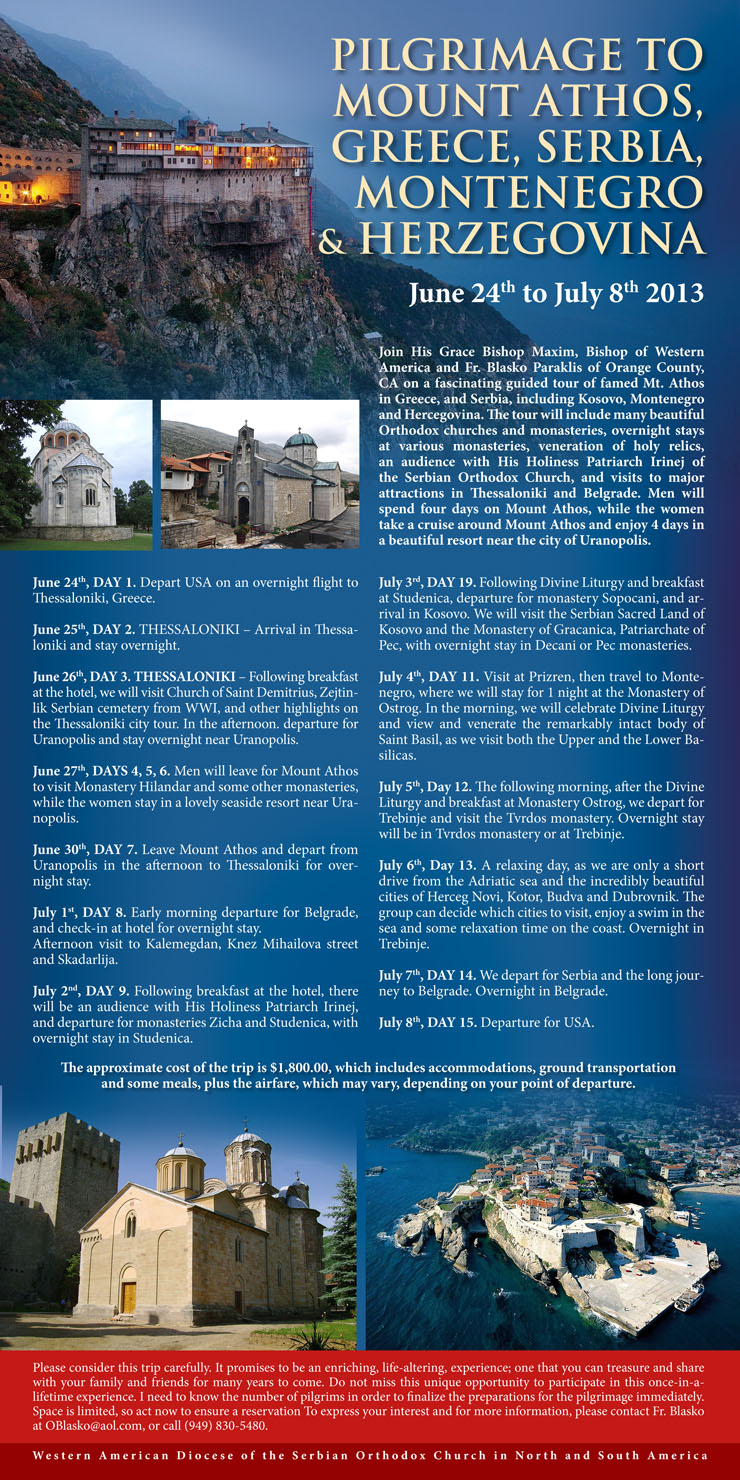
Pilgrimage to Mount Athos, Greece, Serbia, Montenegro & Herzegovina

June 24th to July 8th 2013

Join His Grace Bishop Maxim, Bishop of Western America and Fr. Blasko Paraklis of Orange County, CA on a fascinating guided tour of famed Mt. Athos in Greece, and Serbia, including Kosovo, Montenegro and Hercegovina. The tour will include many beautiful Orthodox churches and monasteries, overnight stays at various monasteries, veneration of holy relics, an audience with His Holiness Patriarch Irinej of the Serbian Orthodox Church, and visits to major attractions in Thessaloniki and Belgrade. Men will spend four days on Mount Athos, while the women take a cruise around Mount Athos and enjoy 4 days in a beautiful resort near the city of Uranopolis.

.

The approximate cost of the trip is $1,800.00, which includes accommodations, ground transportation and some meals, plus the airfare, which may vary, depending on your point of departure.

To express your interest and for more information, please contact Fr. Blasko at This email address is being protected from spambots. You need JavaScript enabled to view it., or call (949) 830-5480.

SA


People Directory

Bishop Hrizostom (Stolić)

(1988–2012)

After the death of Bishop Grigorije the Western Diocese was administered by Irinej, Bishop of Niš, from October 1985 until May 1986, and by Sava, Bishop of Šumadija, from July 1986 until May 1988.

The Holy Bishops’ Assembly at the regular session in May 1988 elected Archimandrite Hrizostom Stolić as a Bishop of the Western Diocese.

Bishop Hrizostom was born in 1939 in Ruma where he graduated from elementary school and middle school (High School). After High School he went to the Dečani Monastery where he took monastic vows. He was ordained to hierodeacon and hieromonk by Rt. Rev. Pavle, Bishop of Ras-Prizren. Soon afterwards he went to America to be at the service to his Church and people. He studied at the Seminary in the Russian Holy Trinity Monastery in Jordanville. He then came to Chicago and helped the pastor at Holy Resurrection Church with his duties. He was appointed temporary pastor of St. George Church in East Chicago, Indiana in 1967. He remained there until 1969. For two years he established firm spiritual roots in the community. He felt a higher calling and responded to it. In 1969 he went to the Hilandar Monastery at Mount Athos in Greece, where he remained for nineteen years. There he was elevated to the rank of archimandrite by the Patriarch of Constantinople, His Holiness Demitrius the First. At one time he was elected a Dean of Mount Athos. He was a librarian in the Hilandar Monastery. Along with the spiritual growth he advanced his intellectual dimensions. He published the Lives of the Holy Fathers in two volumes and the Liturgy of St. Apostle James, which he translated into the Serbian language.

Read more ...

Publishing

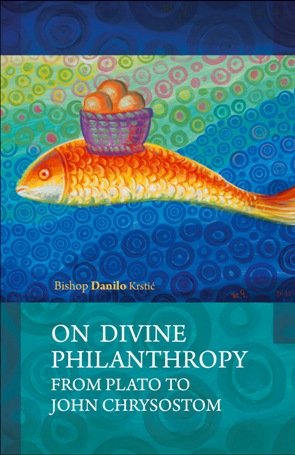
On Divine Philanthropy

From Plato to John Chrysostom

by Bishop Danilo Krstic

This book describes the use of the notion of divine philanthropy from its first appearance in Aeschylos and Plato to the highly polyvalent use of it by John Chrysostom. Each page is marked by meticulous scholarship and great insight, lucidity of thought and expression. Bishop Danilo’s principal methodology in examining Chrysostom is a philological analysis of his works in order to grasp all the semantic shades of the concept of philanthropia throughout his vast literary output. The author overviews the observable development of the concept of philanthropia in a research that encompasses nearly seven centuries of literary sources. Peculiar theological connotations are studied in the uses of divine philanthropia both in the classical development from Aeschylos via Plutarch down to Libanius, Themistius of Byzantium and the Emperor Julian, as well as in the biblical development, especially from Philo and the New Testament through Origen and the Cappadocians to Chrysostom.

With this book, the author invites us to re-read Chrysostom’s golden pages on the ineffable philanthropy of God. "There is a modern ring in Chrysostom’s attempt to prove that we are loved—no matter who and where we are—and even infinitely loved, since our Friend and Lover is the infinite Triune God."

The victory of Chrysostom’s use of philanthropia meant the affirmation of ecclesial culture even at the level of Graeco-Roman culture. May we witness the same reality today in the modern techno-scientific world in which we live.